

Westend61
Airship Renaissance is Pushing Balloon Technology to the Limits
Airships seem like technology from a bygone era. But when a group of British scientists took to the skies above Florida in a Skyship 600, it could have been as champions of a new age in lighter-than-air transport. Drifting among the clouds, it showed there was a place for airships in the 21st century.
The Skyship turned out to be the perfect aerial platform for the team’s Cloud Lab experiments. Over four weeks in 2013, the research craft was filmed flying from Florida to California, gathering data on cloud formation, weather systems, and insect migration. It was an overwhelming win for both airships and science.
British company Hybrid Air Vehicles (HAV) is now making the Skyship’s successor. The Airlander 10 craft is one of a worldwide fleet of airships planned for a zero-emissions economy. All Airlanders will be fitted with electric engines, cutting their flight carbon emissions to zero by 2030.
Each craft is 300 feet (92 meters) long and stays airborne through aerodynamic design and one million cubic feet of lighter-than-air helium gas. The Airlander’s design and fitting are flexible so it can be used to lift 10 metric tons of cargo or take 100 people on short-haul flights.
The ability to land on virtually any flat surface on land, ice, or at sea, and to stay airborne for days, makes the airship attractive for tourist trips to areas inaccessible by most forms of transport. HAV is now working with Swedish company Ocean Sky Cruises planning eco-expeditions to the North Pole by 2024.
Accessing remote locations is central to some of the biggest contracts for airship technology. French firm Flying Whales has developed the rigid 650 meters long LCA60T with a cargo bay capable of carrying 60 metric tons. Vertical take-off and landing will allow the helium-filled airship to deliver timber, wind turbines, or pre-fabricated buildings over the roughest terrain.
Other companies are looking to cash in on the heavy lifting market. Airship do Brasil wants to move cargo across the Amazon rainforest. While Skylifter has an unusual UFO-shaped solar-electric airship, designed to lift payloads weighing up to 250 metric tons in weight.
The scope for commercial airship use is expanding. Dirigibles – from the French verb ‘diriger’, to steer – have a new role in surveillance, security, and communications. Aeros says its Sky Dragon dirigible can be used for threat detection, monitoring critical infrastructures like power plants or military bases, and border patrols.
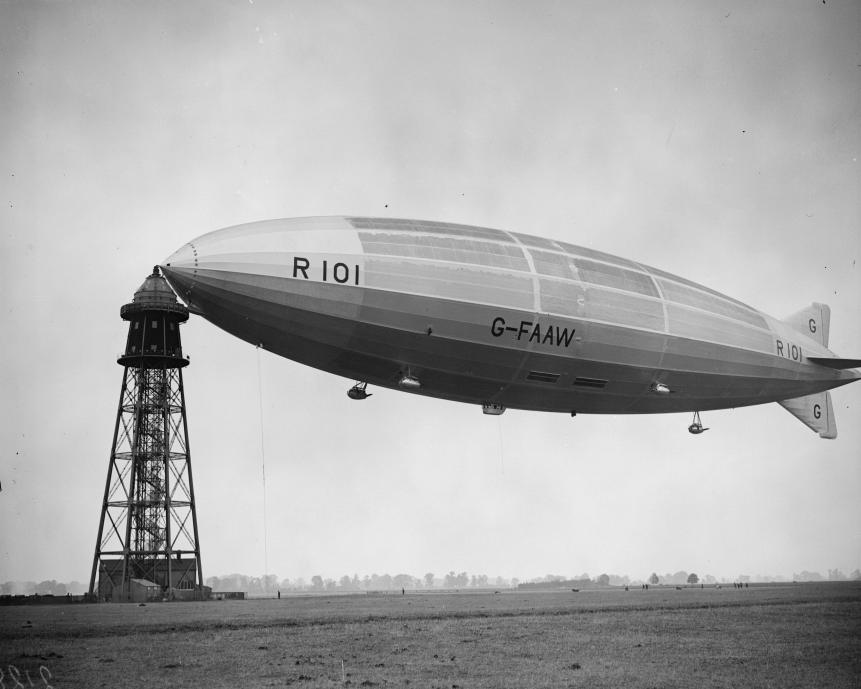
Fox Photos
Airships may seem like technology from a bygone era, but they are taking to the skies again in the 21st century.
Perhaps the final frontier for airships is space travel, but that is a real possibility. California firm JP Aerospace aims to use airships to carry rockets to the edge of space, where they will gradually accelerate into orbit.
And NASA has two airship concepts that are really out there. One is a vacuum airship for Mars exploration – literally, an airship with the air pumped out – and the other is a lighter-than-air exploration vehicle for the upper atmosphere of Venus, where the atmospheric pressure is similar to Earth’s. Neither of these concepts are guaranteed to be used, but they show that when it comes to airships, we are pushing the technology to its outer limits.